2013/03/04
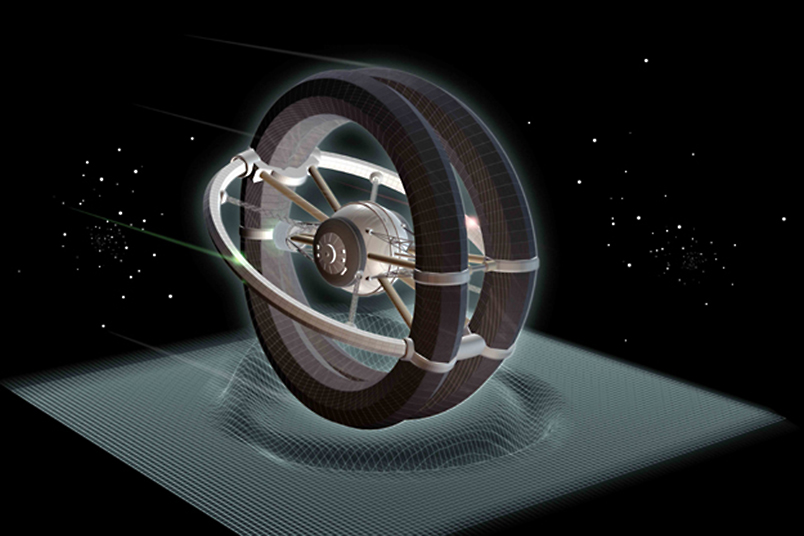
This web site focuses on the propulsion related issues, explaining the
challenges of interstellar travel, existing propulsion ideas, and the
possibilities emerging from scientific literature that may one day provide the
desired breakthroughs. To simplify the presentation for the general public,
analogies to familiar science fiction are used. This site is intended for
public audiences, whereas researchers might want to check out the Breakthrough
Propulsion Physics Project web site.
A Look at the Scaling
The ideal interstellar propulsion system would be one that could get you to
other stars as quickly and comfortably as envisioned in science fiction.
Before this can become a reality, three scientific breakthroughs are needed:
discovery of a means to exceed light speed, discovery of a means to propel a
vehicle without propellant, and discovery of a means to power such devices.
Why? – Because space is big, really, really, really big.
Space takes up a lot of space!
Interstellar distances are so astronomical (pun intended) that it is difficult
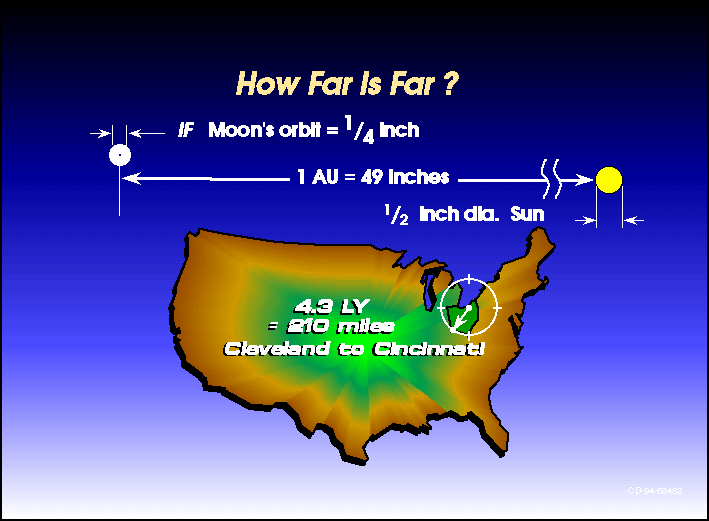
to convey this expanse. Consider the following analogy: If the sun were the
size of a typical, 1/2 inch diameter marble, the distance from the sun to the
Earth, called an “Astronomical Unit (AU)” would be about 4 feet, the Earth
would be barely thicker than a sheet of paper, and the orbit of the Moon would
be about a 1/4 inch in diameter. On this scale, the closest neighboring star
is about 210 miles away. That’s about the distance from Cleveland to
Cincinnati.
To help put this in perspective, consider that it takes light over 8 minutes
to cover that 4 ft “Astronomical Unit” mentioned before. Light is the fastest
thing that we know to exist! Just imagine… How long will take you to travel
210 miles if it takes you over 8 minutes to travel just 4 feet? Actually, the
answer is 4.2 years. Our nearest neighboring star, Proxima Centauri, is 4.2
Light Years away.
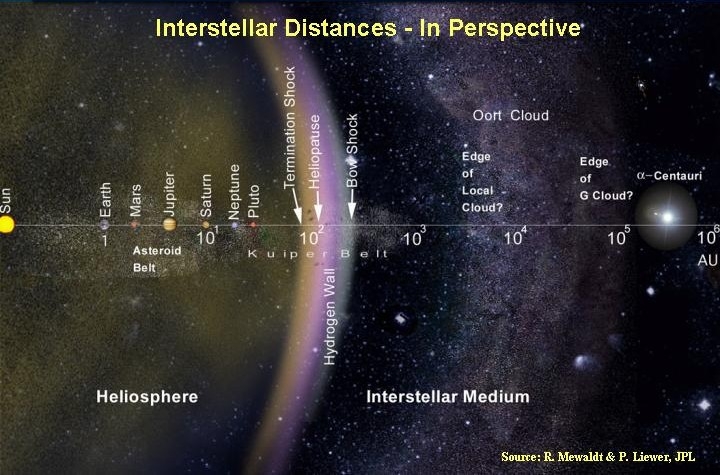
The Voyager spacecraft left the solar system at 37,000 miles per hour. At that
speed, it would take Voyager 80,000 years to reach Proxima Centauri.
Speed: Getting there in a reasonable time – an obvious challenge
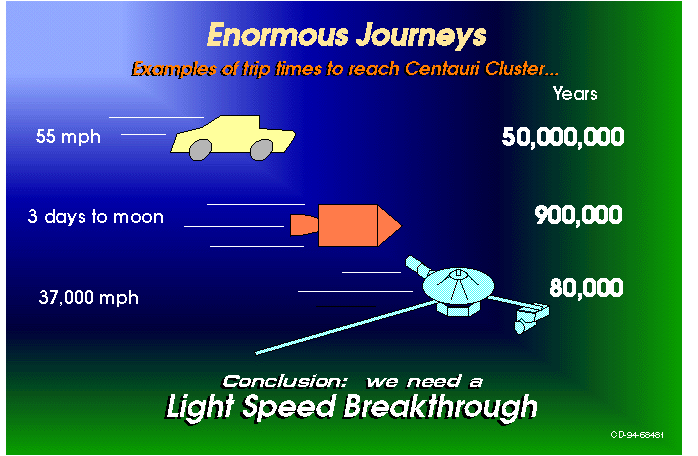
The most obvious challenge to practical interstellar travel is speed. Our
nearest neighboring star is 4.2 Light Years away. Trip times to reach our
nearest neighboring star at conventional speeds would be prohibitively long.
At 55 miles-per-hour for example, it would take over 50 million years to get
there! I don’t think even the twinkies in the glove box would survive that
long. At a more typical spacecraft speed, for example the 3-day trip time that
it took the Apollo spacecraft to reach the moon, it would still take over 900
thousand years. I still don’t think the twinkies will make it. And even if we
consider the staggering speed of 37-thousand miles-per-hour, which was the
speed of the NASA Voyager spacecraft as it left our solar system years ago,
the trip would still take 80,000 years. Maybe the twinkies would make it, but
there would be nothing left on board to eat them. In conclusion, if we want to
cruise to other stars within comfortable and fundable time spans (say, less
than a term in Congress), we have to figure out a way to go faster than light.
Mass: Rockets use too much propellant – a less obvious challenge
A less obvious challenge is overcoming the limitations of rockets. The problem
is fuel, or more specifically, rocket propellant. Unlike a car that has the
road to push against, or an airplane that has the air to push against, rockets
don’t have roads or air in space. Today’s spacecraft use rockets and rockets
use large quantities of propellant. As propellant blasts out of the rocket in
one direction, it pushes the spacecraft in the other — Newton’s third law. The
farther or faster we wish to travel, the more propellant we’ll need. For long
journeys to neighboring stars, the amount of propellant we would need would be
enormous and prohibitively expensive.
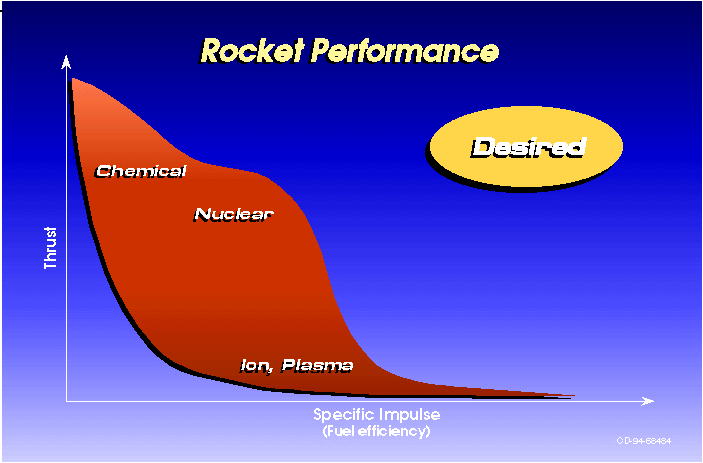
This chart highlights two critical features of a rocket, Thrust and Specific
Impulse. Thrust is how much push a rocket can give. The higher up on the chart,
the greater the push.
Specific Impulse can be thought of as a kind of fuel efficiency for rocket
engines, analogous to the miles-per-gallon for cars. The farther right on the
chart, the less propellant you’ll need. It really has to do with how fast the
fuel blasts out of the rocket.
What you should notice is the red region. This is the range of rocket
performance we can conceivably create with what we know today. And what we
need for interstellar travel is in that desired region or even more fuel
efficient.
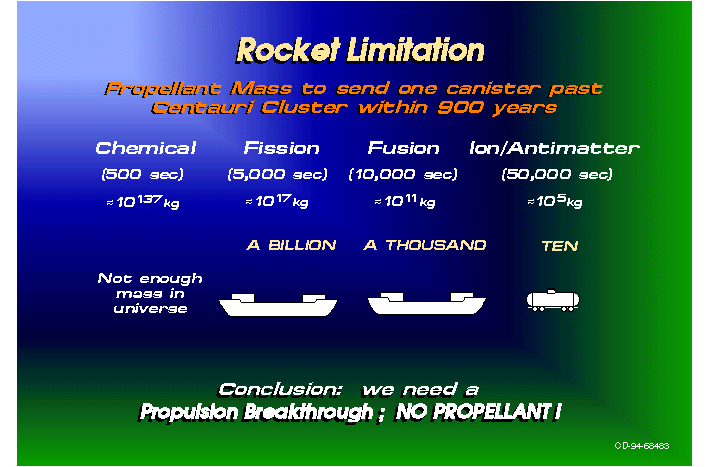
Here are four examples of what it would take to send a canister about the size
of a Shuttle payload (or a school bus) past our nearest neighboring star…and
allowing 900 years for it to make this journey.
Well….If you use chemical engines like those that are on the Shuttle, well…,
sorry, there isn’t enough mass in the universe to supply the rocket propellant
you’d need.
So let’s step up to next possibilities, nuclear rockets with a predicted
performance that’s 10 to 20 times better!
Well…it’s still not looking all that good. For a fission rocket you would need
a BILLION SUPERTANKER size propellant tanks to get you there, and even with
fusion rockets you would still need a THOUSAND SUPERTANKERS!
Even if we look at the best conceivable performance that we could engineer
based on today’s knowledge, say an Ion engine or an antimatter rocket whose
performance was 100 times better that the shuttle engines, we would need about
ten railway tanker sized propellant tanks.
That doesn’t sound too bad, until you consider that we didn’t bring along any
propellant to let us stop when we get to the other star system…or if we want
to get there quicker than 9 centuries.
Once you add the desire to actually stop at your destination, or if you want
to get there sooner, you’re back at the incredible supertanker situation again,
even for our best conceivable rockets.
In conclusion, we’d really like to have a form of propulsion that doesn’t need
any propellant! This implies the need to find some way to modify gravitational
or inertial forces or to find some means to push against the very structure of
spacetime itself.
Energy: – yet another challenge
Our third big challenge is energy. Even if we had a nonrocket space drive that
could convert energy directly into motion without propellant, it would still
require a lot of energy. Sending a Shuttle-sized vehicle on a 50 year one-way
trip to visit our nearest neighboring star (subrelativistic speed) would take
over 7 x 10^19 Joules of energy. This is roughly the same amount of energy
that the Space Shuttle’s engines would use if they ran continuously for the
same duration of 50 years. To overcome this difficulty, we need either a
breakthrough where we can take advantage of the energy in the space vacuum, a
breakthrough in energy production physics, or a breakthrough where the laws of
kinetic energy don’t appl.
From Inspirations to Inventions
Fun Retrospectives & The Future
Right now we don’t even know if practical interstellar travel is possible.
Just because we don’t know how to do something today, however, doesn’t mean
that it is impossible. There is a historical pattern that has emerged where
the grand visions of yesterday’s science fiction inspired today’s reality.
Maybe the same will happen with today’s science fiction.
Here are examples:
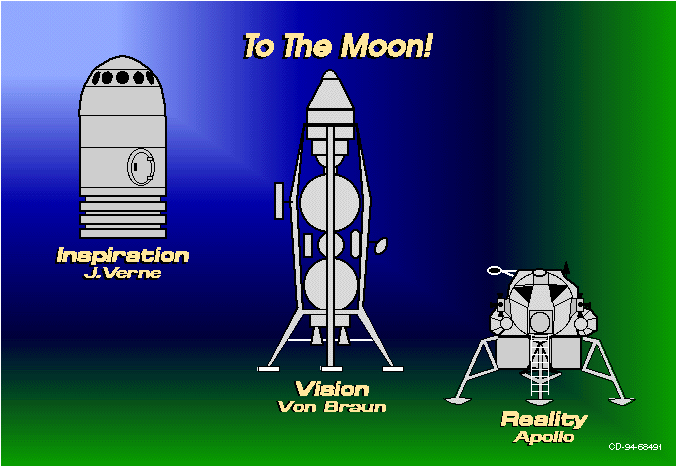
To the Moon – A long time ago, Jules Verne wrote a story about sending people
to the moon by blasting them out of a giant cannon. That story inspired a
whole host of rocketry pioneers who pondered how to make such a journey a
reality. Based on the science of their day, they were eventually able to
create visions of how to achieve such a feat — using rockets instead of
cannons. And, when all the conditions were right, these visions evolved into
reality.
Now, we look back over 25 years to our landing people on the moon and bringing
them back safely.
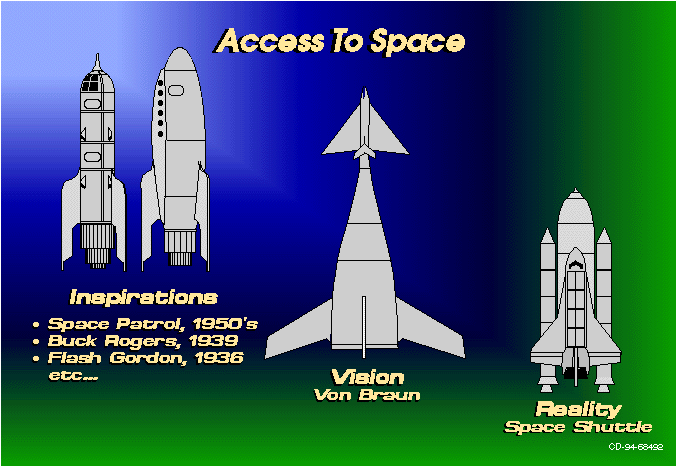
Access to space – This next example is about routine access to space. In this
case the inspirations were from Buck Rogers and Flash Gordon stories with
their rockets gallivanting across space as routinely as that era’s aircraft
flew in the air. Again, such stories inspired rocketry pioneers who created
visions, and reality followed. In this case the Space Shuttle.
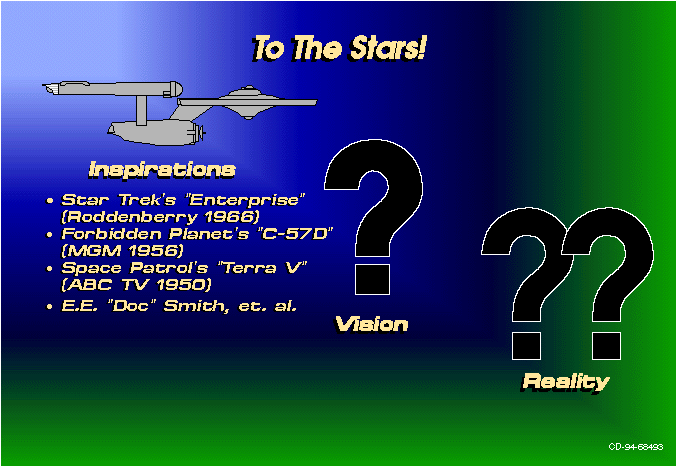
To the stars – And now the inspirations behind this web page – Journeys to the
stars. The idea of “Warp Drives” and “Hyper Space” date back to the 1930’s and
are attributed to John Campbell. Another appropriate example is the 1956 movie
“Forbidden Planet.” Its opening sequence has a prediction of how humanity
conquers gravity and then goes on to discover how to exceed light speed. And a
very well known example is, of course, Star Trek.
But today, we don’t even have the scientific principles from which to create
the visions. First we need to develop such science and then we can engineer
the visions and shape them into reality.
Contemplating an Inspiration
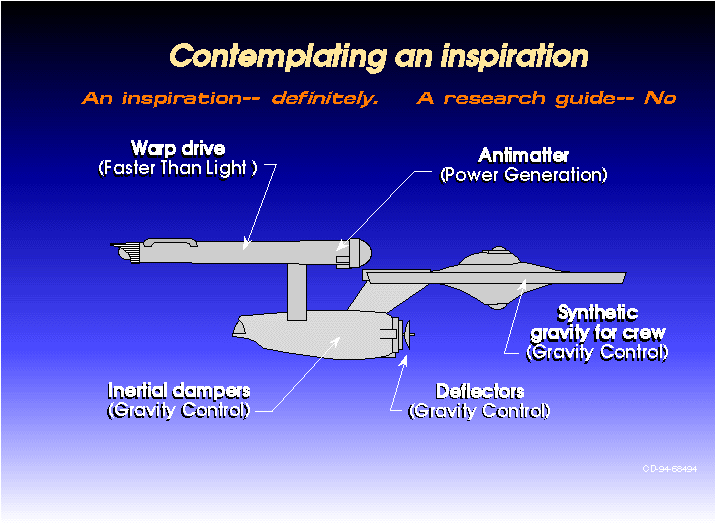
Because of its widespread familiarity, Let’s examine the Star Trek
inspirations.
We would like to point out that although such science fiction vehicles and
ones from other stories like Star Wars are inspirational, they are science
fiction, not research guides for real science. By that we mean that there is
not enough substance behind these vehicles and the techno-speak that is used
to describe them that you could begin a research program. They are however,
inspirational, and they do provide mental pictures that make it easier to
contemplate how you might achieve such feats.
This inspiration shows some of the features we would need for our interstellar
craft.
Faster than light propulsion,sometimes called “warp drive”, “hyperspace drive”,
etc. The point is that we would like some form of propulsion that can get us
there in comfortable timeframes. Also note that this propulsion does not use
propellant — a crucial feature.
Control over gravity. The Trek vehicle has a variety of features that all
imply that we have mastered the control of gravity or inertia: These things
called “Inertial Dampers” on Star Trek are what help keep the crew from flying
out of their seats when the ship maneuvers. The “deflectors” help move objects
out of the way so that the ship doesn’t smash into them at damaging speeds.
And “synthetic gravity” is so the crew can walk about normally. And in movies
this makes their special effects budget much, much smaller.The control over
gravitational forces could also be used to propel the vehicle without the need
for rockets. It is in this propulsion role where the feat of gravity control
would bring the most benefit. If we ever, or should I say more optimistically,
when we conquer gravity, it will be an enormous breakthrough for space travel
and for scientific and technological advances in general. That would usher in
an exciting age for humanity.
Power generation. And to power the vehicle and its propulsion, some form of
power generation is needed. In Trek, they talk a lot about Antimatter, so we
have provided a status on that topic.
Ideas Based On What We Know
The following section has a brief description of some ideas that have been
suggested over the years for interstellar travel, ideas based on the sciences
that do exist today.
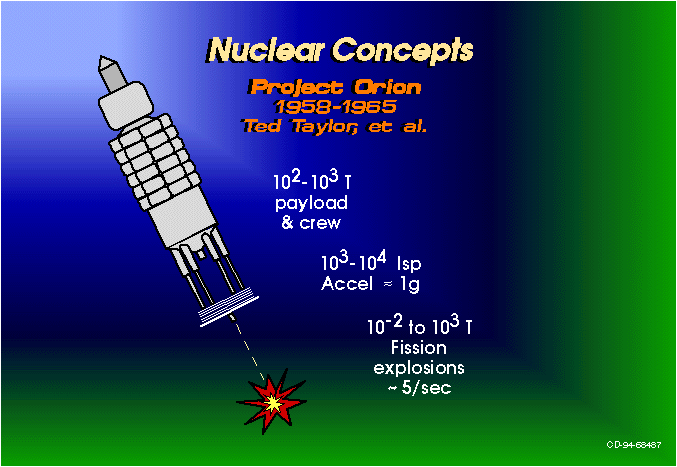
Project Orion
The first example is from the 1950’s-60’s, Project Orion – which offered to
use nuclear bombs for a constructive purpose — space travel.
About 5 bombs per second are dropped out the back and detonated to propel the
craft along. A huge shock plate with shock absorbers make up the base of the
craft. Experiments using conventional explosives were conducted to demonstrate
the viability of this scheme. Although this vehicle was conceived to take a
crew to Mars, it can also be considered for sending smaller probes to the
stars. This project ended with the nuclear test ban treaty in the 60’s.
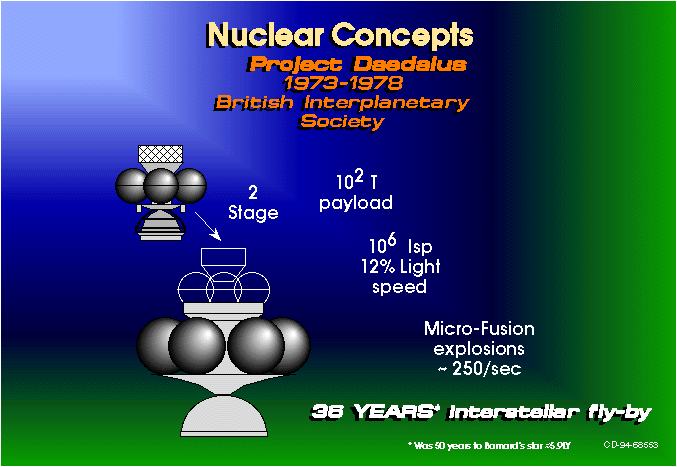
Project Daedalus, British Interplanetary Society
In the late 1970’s the British Interplanetary Society revisited the Orion
propulsion concept, but at a more reasonable scale and for in-space use only.
Project Daedalus was a design study for sending a probe past Barnard’s star
with a 50 year trip time. (Barnard’s star is about 6 Light Years away.) In
this case it used micro fusion explosions which relied on obtaining the
appropriate fuel isotope from Jupiter that it scooped up on its way out of the
solar system — tricky.
Bussard Interstellar Ramjet
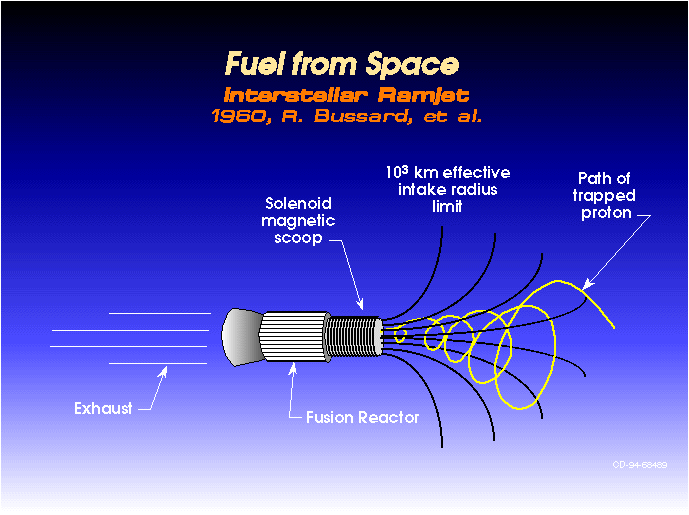
Well, rather than bring your fuel along, why not get it as you go. This
Bussard Interstellar Ramjet concept, from the 1960’s, relies on scooping up
the lonely protons that drift in interstellar space, and then somehow getting
them to fuse to make a nuclear rocket. There are a variety of limitations to
this concept, such as how many protons can be scooped up, the drag created
from scooping them, and, not to mention, the feat of getting these protons to
engage in nuclear fusion for a rocket.
Robert Forward’s interstellar laser sails
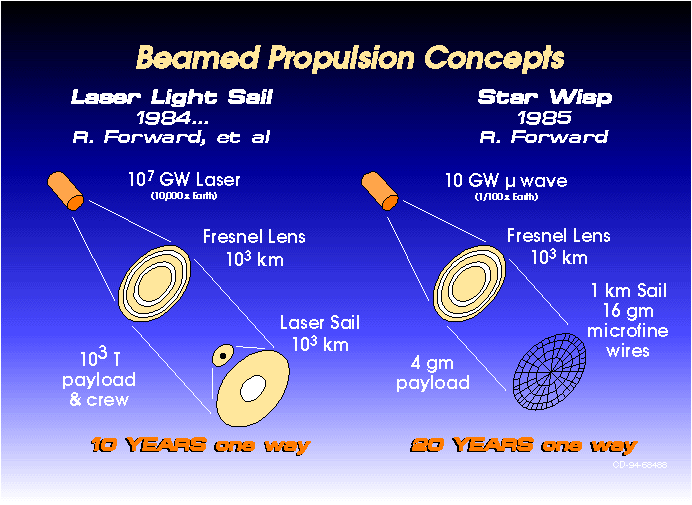
Light sails are another possibility. Rather than use rockets, why not use
light. When light strikes an object, it pushes on it ever so slightly. Use
lots of light over a very large area, and the forces get noticeable. That is
the idea here. Robert Forward proposed using a 10-million-gigawatt laser to
shine through a thousand kilometer Fresnel lens onto a thousand kilometer sail.
With these numbers, it is claimed that one could send a thousand-ton vehicle
with crew to our nearest star in 10 years!
What’s the catch? That 10-million-gigawatt laser. That power level is ten
thousand times more than the power used on all the Earth today.
So, Forward revised the concept to more reasonable power levels. This time it
only has a 10-gigawatt microwave laser (still a feat unto itself), and this
time the vehicle is a frail 16 grams of fine wires spread over just one
kilometer. The sail has all its sensors and stuff built right into its array
of wires.
This and similar concepts are still under investigation. Significant advances
are still required, however, before we can create such systems and before we
have a sufficiently robust space program that could put them in space.
Ideas Based On What We’d Like To Achieve
The following section has a brief description of some ideas that have been
suggested over the years for interstellar travel, ideas based on the sciences
that do exist today.

Worm Hole transportation
Just when you thought it was confusing enough, those physicist had to come up
with wormholes. Here’s the premise behind a “wormhole.”
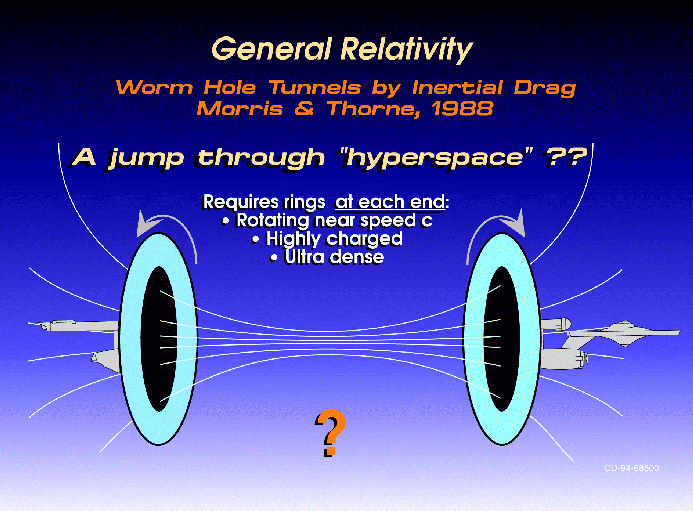
Although Special Relativity forbids objects to move faster than light within
spacetime, it is known that spacetime itself can be warped and distorted. It
takes an enormous amount of matter or energy to create such distortions, but
distortions are possible, theoretically. To use an analogy: even if there were
a speed limit to how fast a pencil could move across a piece of paper, the
motion or changes to the paper is a separate issue. In the case of the
wormhole, a shortcut is made by warping space (folding the paper) to connect
two points that used to be separated. These theories are too new to have
either been discounted or proven viable. And, yes, wormholes do invite the old
time travel paradox problems again.
Here’s one way to build one:
First, collect a whole bunch of super-dense matter, such as matter from a
neutron star. How much?– well enough to construct a ring the size of the
Earth’s orbit around the Sun. Then build another ring where you want the other
end of your wormhole. Next, just charge ‘em up to some incredible voltage, and
spin them up to near the speed of light — both of them.
No problem? Well if you could do all that, and notice you already had to be
where you wanted to go to, I’m sure you could think of more clever ways to
travel. Don’t expect any wormhole engineering any time soon. There are other
ideas out there too – ideas that use “negative energy” to create and to keep
the wormhole open.
Alcubierre’s “Warp Drive”
Here’s the premise behind the Alcubierre “warp drive”: Although Special
Relativity forbids objects to move faster than light within spacetime, it is
unknown how fast spacetime itself can move. To use an analogy, imagine you are
on one of those moving sidewalks that can be found in some airports. The
Alcubierre warp drive is like one of those moving sidewalks. Although there
may be a limit to how fast one can walk across the floor (analogous to the
light speed limit), what about if you are on a moving section of floor that
moves faster than you can walk (analogous to a moving section of spacetime)?
In the case of the Alcubierre warp drive, this moving section of spacetime is
created by expanding spacetime behind the ship (analogous to where the
sidewalk emerges from underneath the floor), and by contracting spacetime in
front of the ship (analogous to where the sidewalk goes back into the floor).
The idea of expanding spacetime is not new. Using the “Inflationary Universe”
perspective, for example, it is thought that spacetime expanded faster than
the speed of light during the early moments of the Big Bang. So if spacetime
can expand faster than the speed of light during the Big Bang, why not for our
warp drive? These theories are too new to have either been discounted or
proven viable.
Any other sticky issues?
Yes… First, to create this effect, you’ll need a ring of negative energy
wrapped around the ship, and lots of it too. It is still debated in physics
whether negative energy can exist. Classical physics tends toward a “no,”
while quantum physics leans to a “maybe, yes.” Second, you’ll need a way to
control this effect to turn it on and off at will. This will be especially
tricky since this warp effect is a separate effect from the ship. Third, all
this assumes that this whole “warp” would indeed move faster than the speed of
light. This is a big unknown. And fourth, if all the previous issues weren’t
tough enough, these concepts evoke the same time-travel paradoxes as the
wormhole concepts.
Negative mass propulsion
It has been shown that is theoretically possible to create a continuously
propulsive effect by the juxtaposition of negative and positive mass and that
such a scheme does not violate conservation of momentum or energy. A crucial
assumption to the success of this concept is that negative mass has negative
inertia. Their combined interactions result in a sustained acceleration of
both masses in the same direction. This concept dates back to at least 1957
with an analysis of the properties of hypothetical negative mass by Bondi, and
has been revisited in the context of propulsion by Winterberg and Forward in
the 1980’s.
Regarding the physics of negative mass, it is not known whether negative mass
exists or if it is even theoretically allowed, but methods have been suggested
to search for evidence of negative mass in the context of searching for
astronomical evidence of wormholes.
Millis’s hypothetical “Space Drives”
A “space drive” can be defined as an idealized form of propulsion where the
fundamental properties of matter and spacetime are used to create propulsive
forces anywhere in space without having to carry and expel a reaction mass.
Such an achievement would revolutionize space travel as it would circumvent
the need for propellant. A variety of hypothetical space drives were created
and analyzed by Millis to identify the specific problems that have to be
solved to make such schemes plausible. These hypothetical drives are just
briefly introduced here. Please note that these concepts are purely
hypothetical constructs aimed to illustrate the remaining challenges. Before
any of these space drives can become reality, a method must be discovered
where a vehicle can create and control an external asymmetric force on itself
without expelling a reaction mass and the method must satisfy conservation
laws in the process.
[Note: This section is excerpted from Millis’ “Challenge to Create the Space
Drive,” in the AIAA Journal of Propulsion and Power, Vol.13, No.5, pp.
577-582, Sept.-Oct. 1997. This 6 page report uses 7 hypothetical space drive
concepts to highlight the unsolved physics and candidate next steps toward
creating a propellantless space drive. It also contains figures for each
concept which are not currently available electronically.]
Hypothetical Differential Sail: Analogous to the principles of an ideal
radiometer vane, a net difference in radiation pressure exists across the
reflecting and absorbing sides. It is assumed that space contains a background
of some form of isotropic medium (like the vacuum fluctuations or Cosmic
Background Radiation) that is constantly impinging on all sides of the sail.
Hypothetical Diode Sail: Analogous to a diode or one-way mirror, space
radiation passes through one direction and reflects from the other creating a
net difference in radiation pressure.
Hypothetical Induction Sail: Analogous to creating a pressure gradient in a
fluid, the energy density of the impinging space radiation is raised behind
the sail and lowered in front to create a net difference in radiation pressure
across the sail.
Hypothetical Diametric Drive: This concept considers the possibility of
creating a local gradient in a background scalar property of space (such as
gravitational potential) by the juxtaposition of diametrically opposed field
sources across the vehicle. This is directly analogous to negative mass
propulsion. The diametric drive can also be considered analogous to creating a
pressure source/sink in a space medium as suggested with the Induction Sail.
Hypothetical Pitch Drive: This concept entertains the possibility that somehow
a localized slope in scalar potential is induced across the vehicle which
causes forces on the vehicle. In contrast to the diametric drive presented
earlier, it is assumed that such a slope can be created without the presence
of a pair of point sources. It is not yet known if and how such an effect can
be created.
Hypothetical Bias Drive: This concept entertains the possibility that the
vehicle alters the properties of space itself, such as the gravitational
constant, G, to create a local propulsive gradient. By modifying Newton’s
constant to have a localized asymmetric bias, a local gradient similar to the
Pitch Drive mechanism results.
Hypothetical Disjunction Drive: This concept entertains the possibility that
the source of a field and that which reacts to a field can be separated. By
displacing them in space, the reactant is shifted to a point where the field
has a slope, thus producing reaction forces between the source and the
reactant. Although existing evidence strongly suggests that the source,
reactant, and inertial mass properties are inseparable, any future evidence to
the contrary would have revolutionary implication to this propulsion
application.
So, can we do it?
Işık Hızında Seyahat Gerçeğe mi Dönüşüyor?