|
11/5/2015
Previously we discussed a few of the past technologies, our limitations in regards to space travel and prominent idea/theories that are being developed and tested right now. We have already discussed the Alcubierre Drive and Em Drive as those concepts are the most popular, but they are not the only the ideas that have been tested and developed. There is the Ion Drive or Ion thruster/ion propulsion, Quantum Entanglement, Wormholes and other theoretical space travel concepts that could be the future of interstellar travel. Ion Thrusters
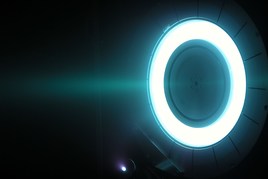
The Ion Drive is a form of electric propulsion used for
spacecraft propulsion which creates thrust by accelerating Ions.
They are classified by the way they accelerating ions by using
either electrostatic or electromagnetic force. The ion
propulsion system is very promising because of its
efficient use of fuel and electrical power enable modern
spacecraft to travel farther, faster, and cheaper than any other
propulsion technology currently available. Ion thrusters expel
ions to create thrust and provide higher spacecraft speed than
any other rocket currently available. Modern Ion thrusters use
inert gases for propellant and the majority of them use xenon.
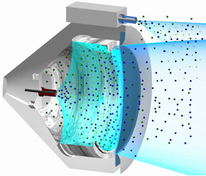
In an ion thruster, ions are accelerated by electrostatic forces.
The electric fields used for acceleration are generated by
electrodes positioned at the downstream end of the thruster.
Each set of electrodes, called ion optics or
grids, contains thousands of coaxial apertures.
Each set of apertures acts as a lens that electrically focuses
ions through the optics. The way Nasa’s ion thrusters work is by
using a two electrode system. An upstream electrode called the
screen grid which is charged highly positive and the highly
negative charged downstream electrode called the acceleration
grid. Due to the fact that the ions are generated in a region of
high positive and the acceleration grid being the high negative
the ions are attracted towards and are focused out of the
discharge chamber creating thousands of ions jets. The thrust
force is created between the upstream ions and the accelerator
grid. The difference between a chemical rockets top speed and an
ion drives top speed is that the chemical rocket’s top speed is
limited by the thermal capacity of the rocket nozzle. While the
ion thruster's top speed is limited by the voltage that is
applied to the ion optics (which is theoretically unlimited) Behind the Scenes : Ion Drive
An ion propulsion system consists of five main parts. The power source, power processing unit, propellant management system, control computer and the ion thruster. While the power source for ion propulsion system can be powered by an sort of electrical power, the ones used most are solar and nuclear. A solar propulsion system uses sunlight and solar power cells for power generation, while a nuclear system uses a nuclear heat source for power generation. Ion thrusters are capable of propelling a spacecraft up to 90,000 meters per second. The only trade off being low output thrust. In order for the spacecraft reach its top speed, it has to stay operated for a very long time. What also makes the ion drive promising is that it is extremely fuel efficient when compared to modern spacecraft fuel. Making it perfect for deep space travel. Wormholes
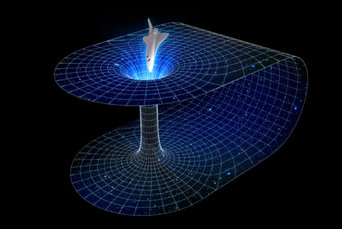
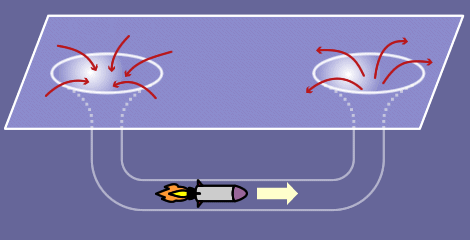
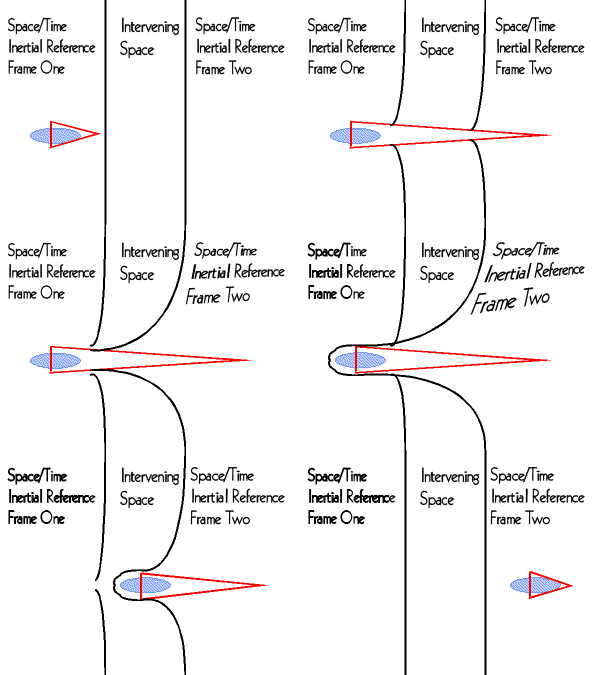
Continuing on from the last weeks theme of unorthodox methods of space travel, wormholes are another proposed method of reaching distant galaxies in short intervals of time. Wormholes are essentially theoretical tunnels in the fabric of space that connect two points in space. it is analogous to to folding a piece of paper in half and poking a hole through it. In doing such, you have opened a “portal” from one side of the paper to the other side without having to travel a great distance. Wormholes work essentially the same way. theoretically, we can bend space (just like the paper) so that two points in the universe come much closer together. unlike the EM drive that was previously mentioned, the wormhole theory does not violate einstein's law of general relativity. While wormholes seem like a good solution to the issues of interstellar space travel, unfortunately it doesn’t seem like we will be travelling in them any time soon.
Wormholes (which are still theoretical by the way) are thought to be incredibly unstable. The wormhole would collapse the instant any object would try to go through it. the Wormhole theory also shares issue with the alcubierre (warp) drive, and that is negative energy. Just like the warp drive, a substance called negative energy is required in order for this theory to work. The problem is, negative energy is a theoretical substance itself and many scientists doubt its existence. Without negative energy, the wormhole will not be able to stabilize and we would not be able to send anything or anyone through it. Another issue with (or solution depending on your point of view) is that travelling through a wormhole may cause you to essentially age slower than everyone else. Suppose your journey in the wormhole lasted a few days. That short journey for you would last years for observers on earth. This allows the people travelling in the wormhole to age incredibly slow. It's essentially like travelling back into the future.
The Future: Alcubierre Drive
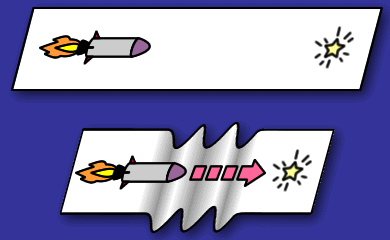
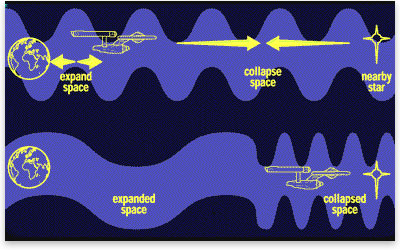
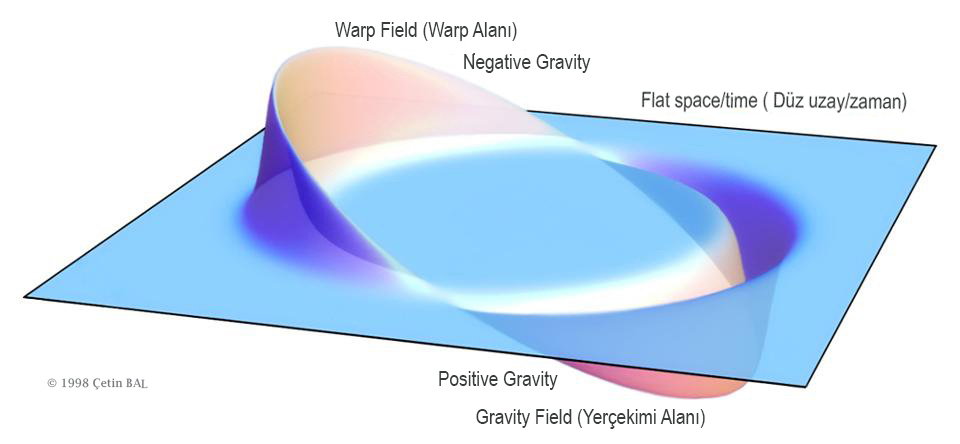
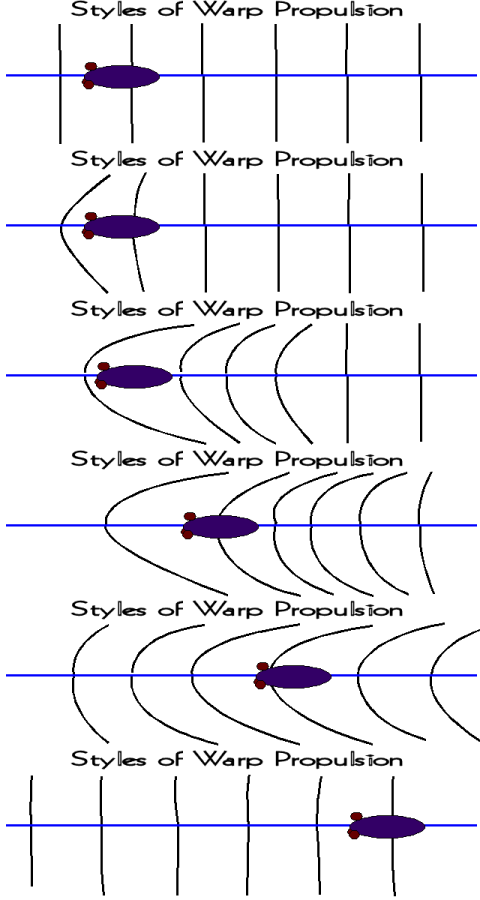
The expansion of space behind is pushing the craft forward and the contraction in front is bringing it closer to its destination. It does this all whilst (technically) travelling faster than the speed of light. What this allows us to do is travel to places like Alpha Centauri, the closest star system to earth, in a matter of two weeks. If it could take us to Alpha Centauri in two weeks imagine what we could find in one year, two years, three years and so on. Technically, we can’t travel THROUGH space faster than light. What the Alcubierre drive does is it bends space. Space is dynamic; there is no limit to how fast we can expand or contract space. So it is technically faster than light travel without violating the laws of relativity because you aren’t technically moving, the space around you is. It seems like there is only positives about the warp drive, but with something positive there is almost always a negative. Some negatives to the drive is that we need a lot negative energy, which is theoretical in itself.
How could we get a lot of negative energy when we can't even get 1 gram? Also it is said that using the warp drive can possibly obliterate everything in its path. For example, after traveling in the warp bubble and arriving close to your destination, the warp bubble you are in will begin to slow down. When it slows down it releases an energetic outburst containing all the matter it picked up whilst in transit. On top of that, we don’t know if people could actually survive in these warp bubbles. So the chance of obliterating entire star systems and killing the entire crew is something to take into consideration. The Alcubierre drive seems like a good solution to our “faster than light problem” but it is based entirely on theory and seems quite unreasonable in our day.
January 28, 2017 by Russell Adam
----------------------------------------------------------- Faster Than Light Travel:– Fact or Fiction?
|
Future space travel
© Çetin BAL -
GSM:+90 05366063183 -Turkey / Denizli